
5 common business problems – Employee Engagement
By Jon CornsIs employee engagement a concern for your business? In part 3 of this unique series of articles addressing 5 common problems SMEs face, Jon Corns takes a closer look at the people dimension, focusing on key ingredients for business success, warning signs and remedies.
Here we are mid way through the 5 business challenges that I commonly see, and this time I want to discuss a topic that’s not only essential to business success, but also impacts the atmosphere and environment of the organisation too. (If you missed the previous articles I suggest you have a look at number 1 complete with my introduction)
As a quick refresher the more I reflect on my own career and the more clients I work with, I realize that irrespective of, organisational size, the maturity of it, its culture and whether its privately or publicly owned, the challenges that business owners and leaders face are actually quite common.
The complexity of the challenge and the answer too it may well vary, but the problems themselves really are the same.
I’ve grouped these problems together into 5 headings,
- Growth & Scaling
- Sales
- Employee Engagement
- Operational Efficiencies
- Succession Planning
Now having touched on Growth, Scaling & Sales, I want to discuss the people dimension within an organisation.
When a business has this right, not only is the performance where you want it to be, but the culture and environment of the business is fun, enjoyable and extremely supportive.
If there are challenges in this area, not only is the opposite true, but it can become all encompassing for the leader, draining time and energy from strategic priorities and business objectives.
What is Employee Engagement?
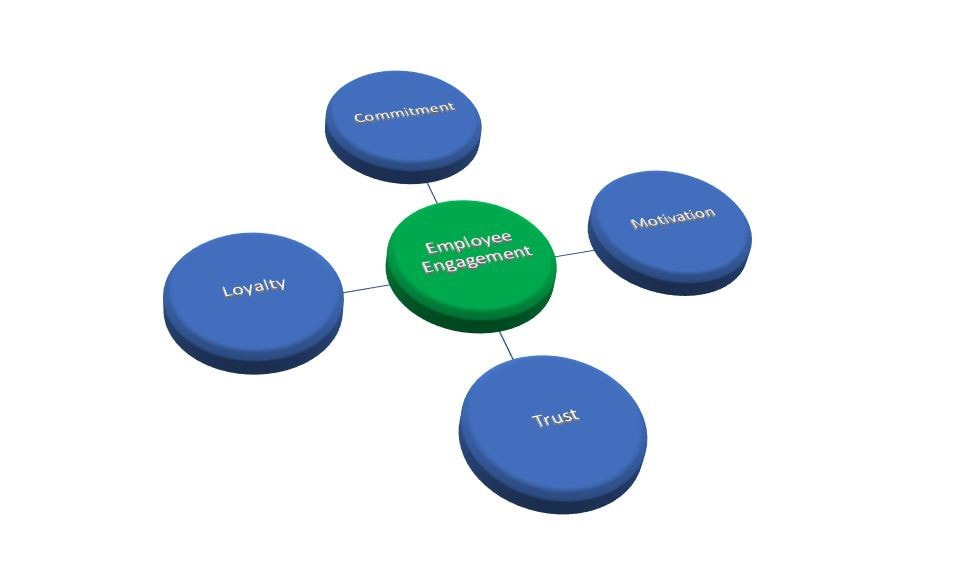
Sorry for a bit of corporate language, but to be honest this is the best phrase I can come up with for the multitude of things that it covers.
In its most simplistic description its specific behaviours of some sort that the business leader / owner wants to encourage, foster or address. The challenge with behaviours is that they are often a symptom of something else and a bit like your health we can alleviate and address symptoms, but to make a lasting permanent improvement we need to cure the underlying issue.
The skill is in the diagnosis. When you live with a condition and don’t address it early the tendency is to treat the symptoms and hope the condition gets better. Over time you accept the condition and start to make allowances for it. Before you know it the condition is your new norm and actually trying to address it then feels like major surgery, so the cure becomes more daunting than continuing to live with it, even though you know it’s not the right solution.
The problem is that any negative behaviour, even from just one individual, is spotted by fellow colleagues (normally before leadership is aware). If left unaddressed it then creates ill feeling, resentment and possibly low morale. The issue is compounded because this is seldom communicated to the business leader / owner who then feels frustrated that the workforce aren’t showing the same emotional attachment to the business.
Ingredients of Employee Engagement
So what can we list under my catch all heading;
- Company culture
- Structure and accessibility to management
- Performance management
- Empowerment & accountability
- Communication
- Teamwork & Team building
- Training & Development
- Reward & Recognition
- Values and the way people interact with each other
- Morale
- Recruitment & On-boarding
Even if it’s been in an informal way all businesses will have had to consider these points, how to deliver them, what they look like, processes for them and some organisations do all of these really well. The ones that do have, high performing, long serving, loyal employees who are advocates for the business.
If we are truly honest with ourselves as leaders though there is always an element that we can do better, and time is often our excuse, but it shouldn’t be the reason why we downplay the importance or significance of the impact it could have on our businesses.
The Warning signs
If you have any of the following symptoms, you probably need to step back and assess your employee engagement, especially following the past 12 months.
- Work to rule mindset (my hours are 9-5 and that’s what I will work)
- Blame, this can also manifest as a victim mentality.
- Rumours and gossip
- Disengagement (people missing from desks, finding other tasks to do, prioritising personal activities in the workplace)
- Underperformance
- Tasks left incomplete
Now just because you may have some of these symptoms doesn’t mean you have poor people. In fact I really don’t believe that many, if any, employees ever come to work with the intent of doing a mediocre or poor job. (Unless they have mentally quit)
The real skill in addressing these is to hold the mirror up to ourselves as leaders and ask whether we have contributed to or actually fostered some of the issues that concern us.
For example have we committed to some training and not delivered it because a business need has distracted us or taken the budget that was intended for this?
Do we communicate regularly and concisely enough? (If not people will always draw their own conclusions). Have we identified and accommodated peoples communication style preferences?
Remedies to improve Employee Engagement

So assuming there is an area of concern how do we address it?
The real answer depends upon the size of your business and the scale of the challenge.
But assuming its not just one individual at the heart of the issue then here is my roadmap to tackling employee engagement.
- Solicit feedback – create a way that people can provide candid feedback anonymously (depending on how many people you have an employee survey is ideal)
- Understand what is important to your workforce (its often not what you expect it to be)
- Communicate! – Tell people the journey the business is on, how you expect the get there, the benefits of getting there, how important the role they play is to the journey and what the obstacles are to overcome.
- Communicate! – (no its not a mistake, its to highlight how important this is) Update your workforce on the above. Discuss progress, challenges, but do this often and collectively. If everyone is hearing the same message, at the same time, in the same forum it reduces the risk of interpretation.
- Pick something from their feedback and make a commitment to address it. – Deliver what you commit to.
- Celebrate success, – people like good news and most also like recognition. It doesn’t have to be high value, but recognition motivates.
- Create a safe environment for candor. Candid feedback is so important, but it has to be delivered in a non-threatening way. People will only accept candor if it is not delivered as a personal attack, isn’t constructed as blame, and doesn’t feel like a disciplinary.
- Empower people. Demonstrate trust in them and allow them to take ownership. This means it may be done differently to how you would do it, but provided the outcome is as required, on time and without additional cost, then it doesn’t matter. Often they actually find a more efficient or effective way of delivery.
- Hold people accountable. This can only work once they are empowered, but with empowerment comes accountability.
- Allow people to make mistakes. – Now this comes with some caveats. Mistakes that cost the business money or customers are obviously serious and need to be avoided or mitigated, but I’ve seen too many companies where employees are so scared of making a mistake that they either never own it when they make one, or their default answer just becomes “NO.” You have to create an environment where people feel safe to make a mistake as long as they learn from them and don’t make the same ones repeatedly.
- Address undesirable behaviours, this doesn’t have to be a negative experience, but it does need to be done immediately. Failure to address it immediately is tacit acceptance and undermines other employees. (Its always much more negative for the individual involved if you don’t address it as soon as you are aware of it.)
- Be open to feedback! – As business leaders we should be big enough and ugly enough to handle bad news. We don’t have to like it, but we do have to accept it and then we can ask what people are doing about it? The reason this is so important is that I have seen employee’s so scared of a leaders reaction that instead of being truthful they tell that individual what they assume he/she wants to hear. Now that leader is making business decisions no longer based on reality, but on mis-information. This seldom has a good outcome.
- Hold yourself accountable at least as much as you hold others! If you hold others accountable to deadlines, attention to detail, time keeping (whatever it may be) but then cut yourself some slack in these same areas, the are on a slippery slope. People will see through it very quickly and this is a rapid way to losing both respect and engagement. Lead by example!
Of course this is quite generic and each of these points has different ways of implementation, but so much depends on, size of workforce, company culture, maturity of the business, the sector it sits within, etc, that its not possible to adopt a one glove fits all approach.
With so many employees coming back to work from Lockdowns, Furlough and in many cases a new way of remote working, now is the ideal time to put a framework in place to get the best from your employees and to show them just how much you appreciate them.
As always happy to discuss my views around this in more detail and always willing to support anyone in need of a bit of help. Feel free to contact me via the form below or connect with me on LinkedIn.